
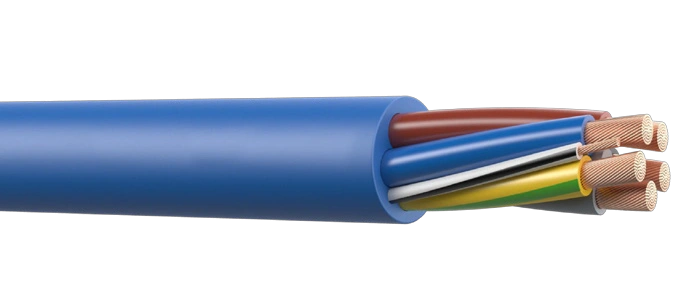
A tethered wallbox cable is handled every time the vehicle is charged. For a charger manufacturer or cable-assembly business, selecting it means balancing the electrical requirement with the way customers lift, route and store the finished lead.
LEONI EcoSense Nxt is an AC charging-cable range designed to improve handling through changes to the cable compounds, cores and production process. Here is what to establish before choosing a construction for your wallbox project. [1]
Start with the charging system
Define the intended AC charging arrangement, connector, operating voltage and current before selecting a conductor cross-section. Include the required finished length and whether the product will serve a single market or several.
LEONI’s EcoSense portfolio covers single-phase and three-phase AC applications, with straight and coiled options. The dedicated Nxt brochure identifies Type 2 applications in Mode 2 and Mode 3. These are portfolio descriptions: the selected cable still needs to match the particular charger and assembly specification. [1][2]
The cable enquiry should therefore begin with the equipment brief, rather than a request for a particular diameter or a cable that simply looks similar to an existing lead.
Include power and control requirements
LEONI’s AC charging brochure describes constructions with three to five power cores and options for up to eight control cores. The number of control wires can be adapted to the requirement. [3]
For an initial review, provide the complete core arrangement, including protective earth and the required control or signal conductors. Add the connector pin assignment and identify any requirements already fixed by your charger design.
This helps avoid an incomplete quotation based only on the power conductors. If you are replacing an existing cable, send its drawing or datasheet alongside the proposed changes so that both constructions can be reviewed on the same basis.
Assess handling on a finished sample
LEONI reports an average outer-diameter reduction of 4% and average weight saving of 6% for EcoSense Nxt against conventional models. Nxt+ combines the Nxt developments with power-optimised cores. These comparisons describe the manufacturer’s published development results, not guaranteed savings for every proposed construction. [2]
Use those figures as a reason to investigate a sample, then assess the actual lead you intend to build.
Can the user comfortably lift and guide it into the vehicle inlet? Does it sit neatly on the wallbox’s storage arrangement? Is there enough useful reach after accounting for the connector and the route around a parked vehicle?
Include your assembly team in that review. Confirm that the selected cable can be prepared, terminated and inspected using the intended production process.
Check connector fit and the installation environment
Request the exact cable outside diameter and tolerance, conductor construction and applicable bend requirements. Compare these with the connector, cable entry, seal and strain-relief specifications before approving the combination.
Describe where the wallbox will operate: indoors or outdoors, the expected temperature range, likely moisture exposure and the handling duty. Ask for evidence against the relevant requirements for the exact cable.
A sample review should cover both ends of the assembly, including the wallbox entry and the vehicle connector. Record the agreed cable reference and drawing revision so that subsequent orders use the same specification.
Confirm the destination market
LEONI’s AC brochure lists IEC 62893, EN 50620, UL 2263, GB/T 33594 and Japanese requirements across its regional portfolios. That does not mean every construction carries every approval. [3]
State the destination countries at the enquiry stage and request the applicable certification for the proposed reference. Keep the cable’s documentation alongside the evidence required for the complete charging assembly.
Bring the brief to HB Cables
Explore the LEONI EcoSense charging range and its EcoSense Nxt brochure, then send HB Cables your charging-cable brief.
Include the electrical requirement, core arrangement, connector references, finished length, handling conditions and target markets. Add sample quantities, expected production demand and your required timing so that we can review the construction and supply options with you.
Manufacturer pages and linked brochures checked 2 November 2026.