
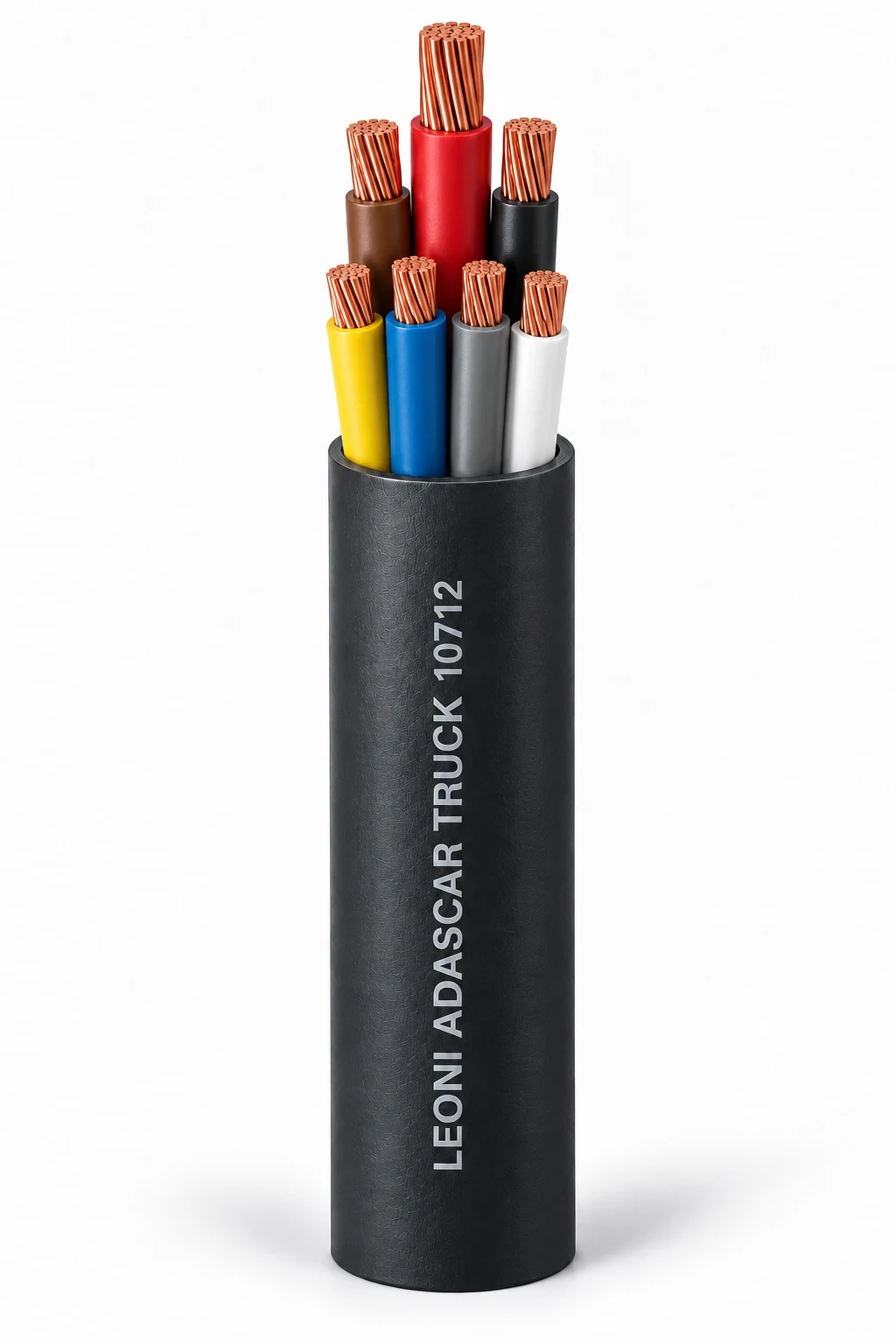
A request for “seven-core ADR cable” is a useful starting point. To select a cable for a working harness, it helps to add the size of each core, the installation conditions and the approval documentation your project requires.
LEONI Adascar Truck includes multicore and multifunction constructions for truck and trailer wiring. Here is how to turn a general requirement into a clearer cable brief.
1. Check the exact approval scope
LEONI’s Truck & Trailer publication lists ADR certificates against defined cable constructions, insulation and jacket materials, temperature ratings and production facilities. The approval review therefore needs the exact cable reference and the relevant certificate.
Ask for the current datasheet and approval evidence for the proposed supply. The vehicle or harness approval process should confirm that the selected cable and its installation meet the project’s requirements.
2. Specify the size of every core
Multicore does not necessarily mean that all conductors have the same cross-section. LEONI’s published Truck 10151 example has 12 × 1.0 mm² plus 3 × 2.5 mm²: fifteen cores in total, arranged in two size groups.
For your own requirement, list each circuit and the conductor size specified by your engineering team. Include any twisted pairs or integrated data elements explicitly so the cable supplier can compare the complete construction.
| A general request | A more useful specification |
|---|---|
| “Seven-core cable” | Total core count plus the quantity and size of each conductor group |
| “Fifteen-core cable” | For example, 12 × 1.0 + 3 × 2.5 mm², if that is the required arrangement |
| “Cable for data and power” | Data interface, pair arrangement, screening requirement and power-core sizes |
3. Describe where it will be installed
Give the supplier the actual cable route: fixed chassis wiring, a moving connection or an interconnection between truck and trailer. Include the available space, connector entry dimensions, bend radius and any repeated movement.
LEONI’s Truck portfolio includes designs for coiling and overmoulding. Check those capabilities for the specific type you are considering; they should form part of the selection brief.
4. Include the operating conditions
Tell HB Cables the required temperature range and exposure to oils, fuels, cleaning fluids, moisture or abrasion. Provide the applicable customer specification so the proposal can be checked against documented requirements.
If the cable is part of an existing approved assembly, share the current datasheet, connector references and drawing. These make it easier to identify what a replacement must match.
5. Plan samples and production supply
Include sample lengths, the first production quantity and expected annual usage in your enquiry. Let us know whether you need cut lengths or drums, and your target delivery date.
That helps us review technical suitability alongside availability, stockholding and repeat supply.
Find the right Adascar Truck construction
HB Cables is the exclusive UK distributor and stockholder for LEONI Cable Solutions. Send us your core arrangement and application brief to discuss technical information and supply options.
Discuss your truck cable