
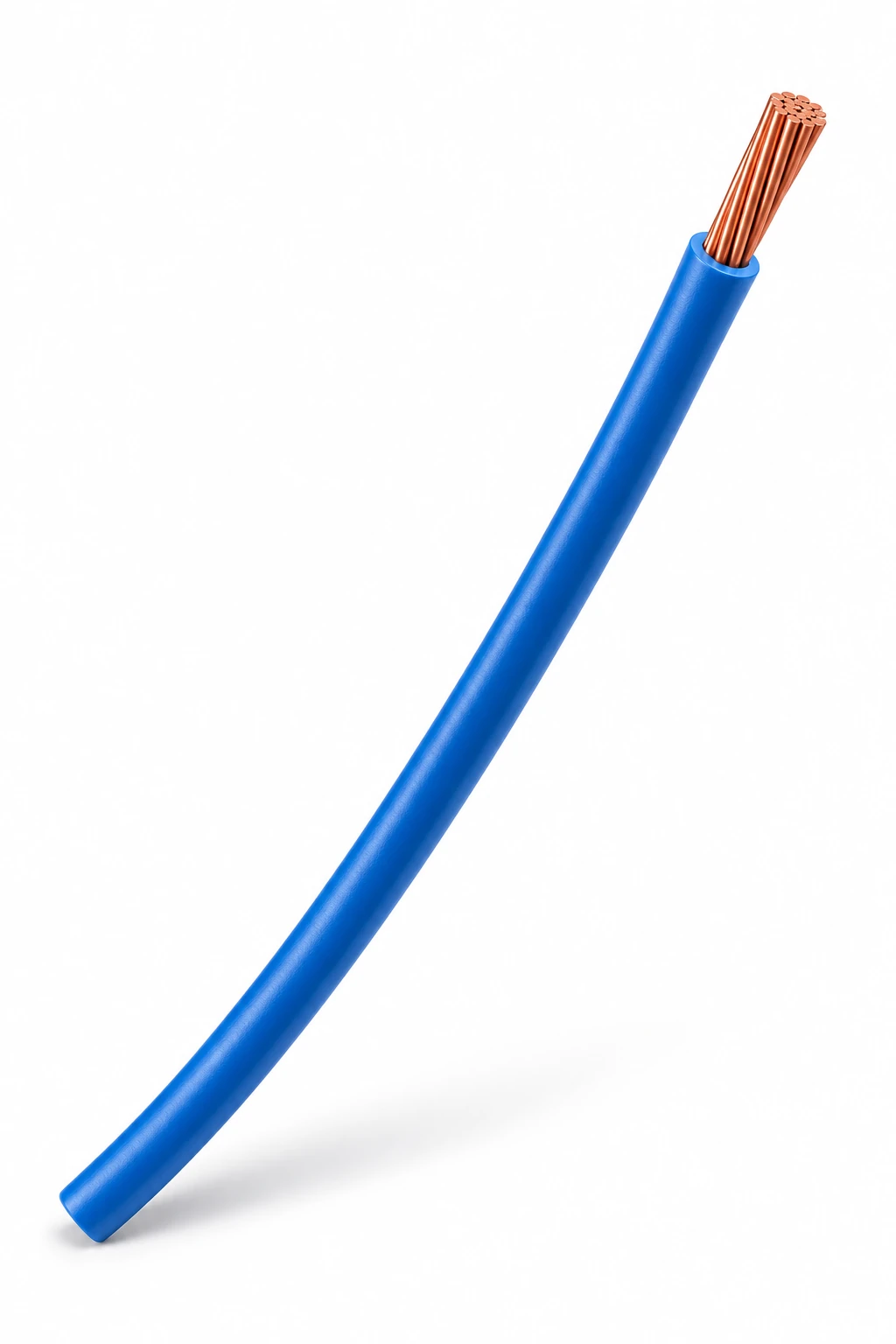
Specifying FLRY wire for a vehicle harness involves more than choosing a cross-section and colour. The useful starting point is the circuit, the connector and the installation route. Getting those details into the enquiry helps you compare the right constructions before committing to a production order.
LEONI’s automotive cable catalogue describes FLRY Type A and Type B as thin-wall PVC-insulated wires with soft-annealed copper conductors, available bare or tinned. It gives a temperature range of −40°C to +105°C on a 3,000-hour basis. Treat these as catalogue details to check against the exact proposed reference. [1]
Start with the circuit requirement
Tell HB Cables the system voltage, continuous current, peak load and circuit length. Include the permitted voltage drop and explain how the wire will be installed: for example, within a taped bundle, through a conduit or alongside other loaded circuits.
Ask for a review of the proposed cross-section against those conditions. A request for “0.5 mm² automotive wire” gives a supplier much less to work with than a circuit brief and drawing.
For a replacement, provide the existing manufacturer reference and specification revision. Highlight any changes to the electrical load or routing since the original harness was approved.
Specify Type A or Type B explicitly
LEONI publishes separate conductor constructions for the two types. For example, its 0.5 mm² FLRY-A entry lists 19 strands, while the corresponding FLRY-B entry lists 16. Both have a listed maximum outside diameter of 1.6 mm. These are examples from the catalogue, rather than a specification for every orderable variant. [1]
The practical lesson is to identify the required type and strand construction alongside the cross-section. If a drawing specifies FLRY-A, make any proposed change to FLRY-B part of the engineering review.
Ask your assembly team to check the proposed wire against its terminals, seals, stripping settings and crimp process. Review a sample through the intended assembly operations before releasing a substitution.
Check the complete installation route
Mark the demanding sections of the harness drawing: tight passages, connector exits, clips, hot areas and places exposed to fluids or movement. Describe each one when requesting the cable.
Ask for the applicable temperature, fluid-resistance and mechanical test evidence for the selected construction. Where a section moves in service, describe the movement and expected duty so that suitability can be assessed specifically.
LEONI lists FLRYK separately as a cold-resistant thin-wall design and FLRYW as a hot-pressure-resistant design. Those additional letters identify different catalogue products; they should be included accurately in drawings and enquiries. [1]
Make colours and approvals part of the brief
Prepare a wire schedule showing each circuit’s cross-section, type, base colour and any required stripe or marking. Identify which colours are mandatory and where alternatives could be considered.
Include the customer or vehicle manufacturer’s specification, required evidence and any approved-source restrictions. Ask for confirmation against the exact supplied reference, with the relevant datasheet revision recorded in your purchasing documents.
For repeat builds, retain the agreed wire schedule with the harness drawing. This gives purchasing and production a common reference when discussing future orders or proposed changes.
Build a shortlist with HB Cables
Browse the HB Cables FLRY range and review published references such as LEONI FLRY-A 0.5 mm² and LEONI FLRY-B 0.75 mm².
Then send HB Cables your wire schedule or drawing, together with prototype quantities, expected production demand and required timing. We can review the construction and supply options with you, and confirm the exact specification and availability before quoting.
Manufacturer sources checked 16 November 2026. The catalogue is the February 2019 issue currently linked from LEONI’s single-core cables page; catalogue guidance requires confirmation against the exact supplied reference.
- LEONI Automotive Cables catalogue, printed pages 30–33: FLRYK, FLRY Type A / Type B and FLRYW. Manufacturer’s current single-core cables page.