
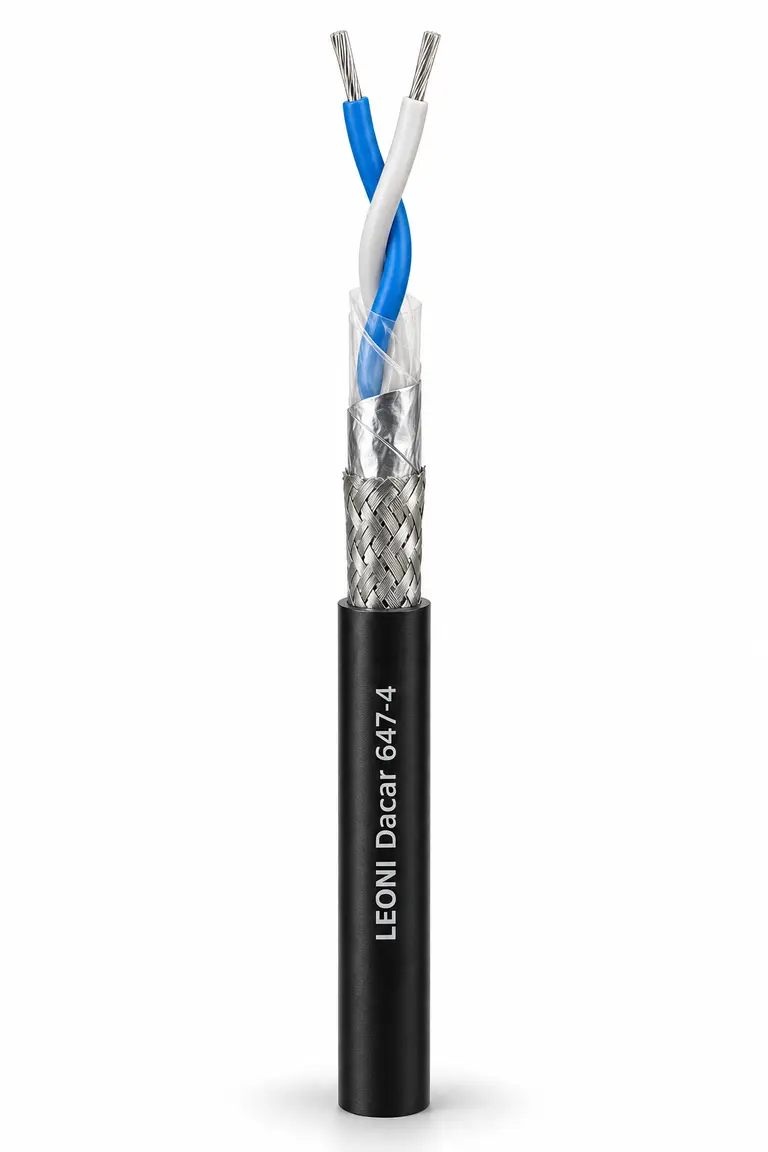
If you are specifying an automotive Ethernet cable, Dacar 647 and Dacar 647-4 can look very similar on a shortlist. Their shared conductor size and published data-rate class make it tempting to treat them as interchangeable. Their screening construction is the first difference to check.
The main difference: UTP versus STP
LEONI’s published automotive Ethernet portfolio identifies Dacar 647 as UTP, or unshielded twisted pair, and Dacar 647-4 as STP, or shielded twisted pair. Both are listed with two 0.13 mm² CuSn03 copper-alloy conductors and 1 Gbps performance.
| Published characteristic | Dacar 647 | Dacar 647-4 |
|---|---|---|
| Construction | Unshielded twisted pair | Shielded twisted pair |
| Nominal conductor size | 2 × 0.13 mm² | 2 × 0.13 mm² |
| Conductor material | CuSn03 copper alloy | CuSn03 copper alloy |
| Published data-rate class | 1 Gbps | 1 Gbps |
| Published temperature range | −40°C to +105°C | −40°C to +105°C |
What does the screen change?
The practical question is whether your system calls for an unshielded or shielded link. Ask the harness designer which construction has been specified and validated, and how a screen would be terminated at each end.
For Dacar 647-4, review the approved connector and termination instructions alongside the cable. Rosenberger’s H-MTD catalogue, for example, lists 647-4 within its 100 Ω shielded cable groups. Use the exact connector part and cable group when checking compatibility.
Can one replace the other?
Treat a substitution as an engineering review. Start with the approved cable reference, then compare the proposed alternative’s current datasheet and the complete assembly requirements.
Ask your engineering team to confirm:
- The required Ethernet interface and channel performance.
- Whether the harness must be shielded or unshielded.
- The connector’s approved cable dimensions and termination method.
- The cable route, operating conditions and required validation.
These questions are particularly useful when an alternative is being considered because of availability. A shared conductor size alone is too little information to sign off a change.
What to include in your enquiry
Send HB Cables the existing Dacar type or LEONI part number, connector references, required length and quantity. For a new design, include the interface specification and installation brief so we can help narrow the selection.
Ask HB about Dacar 647-4
We can help you obtain the relevant technical information and check supply options for your project.
Discuss your Ethernet cableLEONI automotive Ethernet portfolio, inTEAM 1/2023 · Rosenberger H-MTD connector catalogue